

The Lesson Isn’t Her Style. It’s Her Selfhood.
How in the 90's, Carolyn Bessette shaped my teenage sense of self.
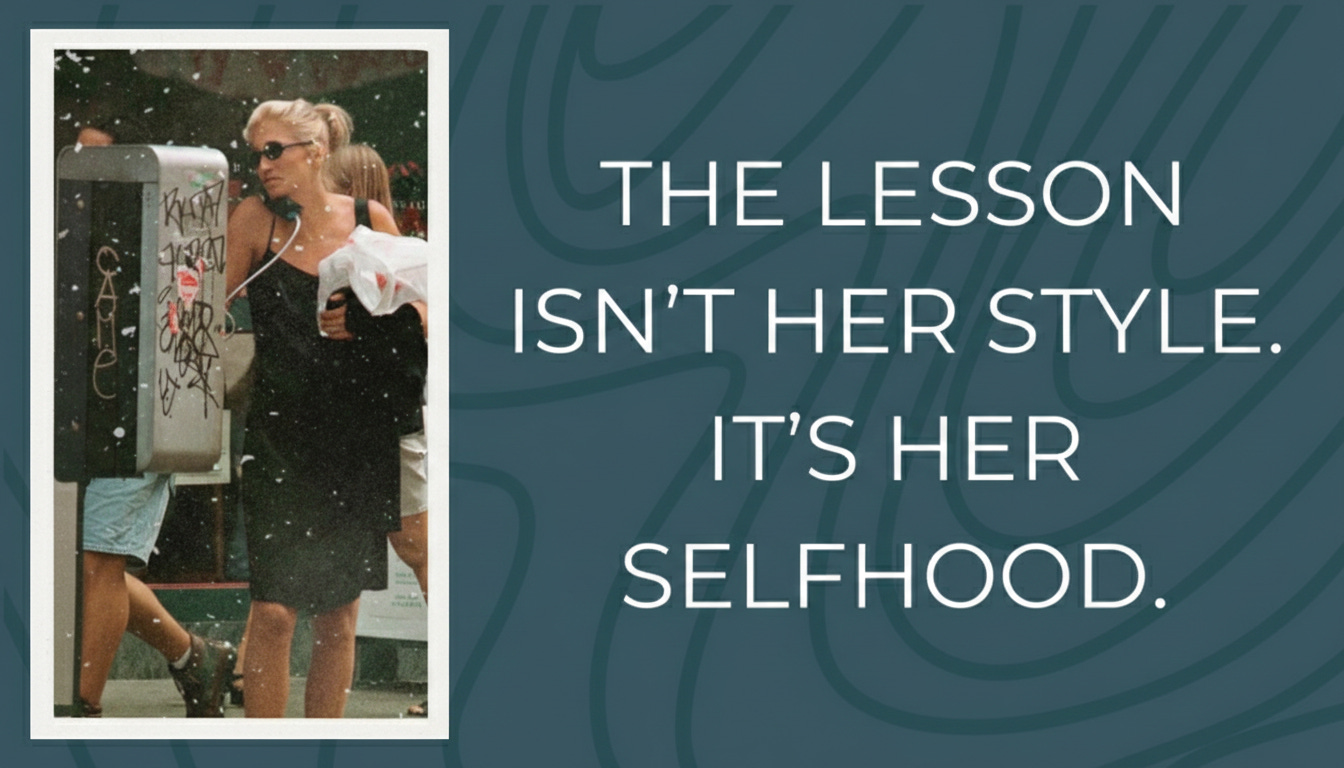
I first learned of Carolyn Bessette’s death while sitting at my summer internship in the original Miramax offices. Someone passed around a CNN link, opened in a browser that felt barely capable of holding the news. The room didn’t stop, exactly, but something inside me did. It was the first time I understood that a person could belong to a city’s atmosphere—that their absence could actually thin the air.
Carolyn wasn’t just a public figure; she was part of the visual grammar of the New York I grew up in.
It’s only now that I see how much of my own aesthetic was shaped in her shadow. I spent years wanting to be the “wash-and-go” girl who looked impossibly composed. The hallmarks were simple: no jewelry, air-dried hair, a wardrobe of quiet luxury before that term became a marketing pivot. I was chasing a specific kind of power—a woman who didn’t chase men, but allowed herself to be pursued; who didn’t disappear inside relationships, but insisted they make space for her.
At the time, I believed these choices were a quiet rebellion. My mother wore a full face of makeup to the gym, moving through the world in a state of permanent readiness, as if perfection were a civic duty. My refusal—the bare face, the undone hair—felt like dissent.
Now I understand it wasn’t dissent. It was alignment.
I wasn’t rejecting femininity; I was reaching toward a different version of it—one Carolyn had already modeled. It was a self-possession that didn’t require ornamentation, a presence that didn’t apologize for taking up space.
Lately, as Instagram fills with forensic analyses of her life through the lens of the latest Ryan Murphy production, I’ve found myself less interested in the accuracy of the portrayal than in the collective remembering it’s sparked. Because what’s resurfacing isn’t just a “look.” It’s a philosophy. It’s an understanding of New York as a place where women move with purpose and restraint—where strength doesn’t cancel out femininity, and ambition doesn’t preclude softness. Where being seen isn’t the goal, but being fully oneself is.
Reading these reflections feels less like nostalgia than a startling recognition. It’s the discovery that something I thought I had invented was, in fact, inherited.
For years, I strived to embody that energy—to approximate the restraint I associated with her. But the silhouette and the minimalism were just the shell. What actually appealed to me was the unapologetic coherence of a woman who seemed entirely herself. I’ve realized I don’t want to be Carolyn. I want to be unmistakably, irreducibly me—moving through the world with that same clarity of self, whatever form it takes.