

Confessions from an AI Addict
The story of a writer finding her voice
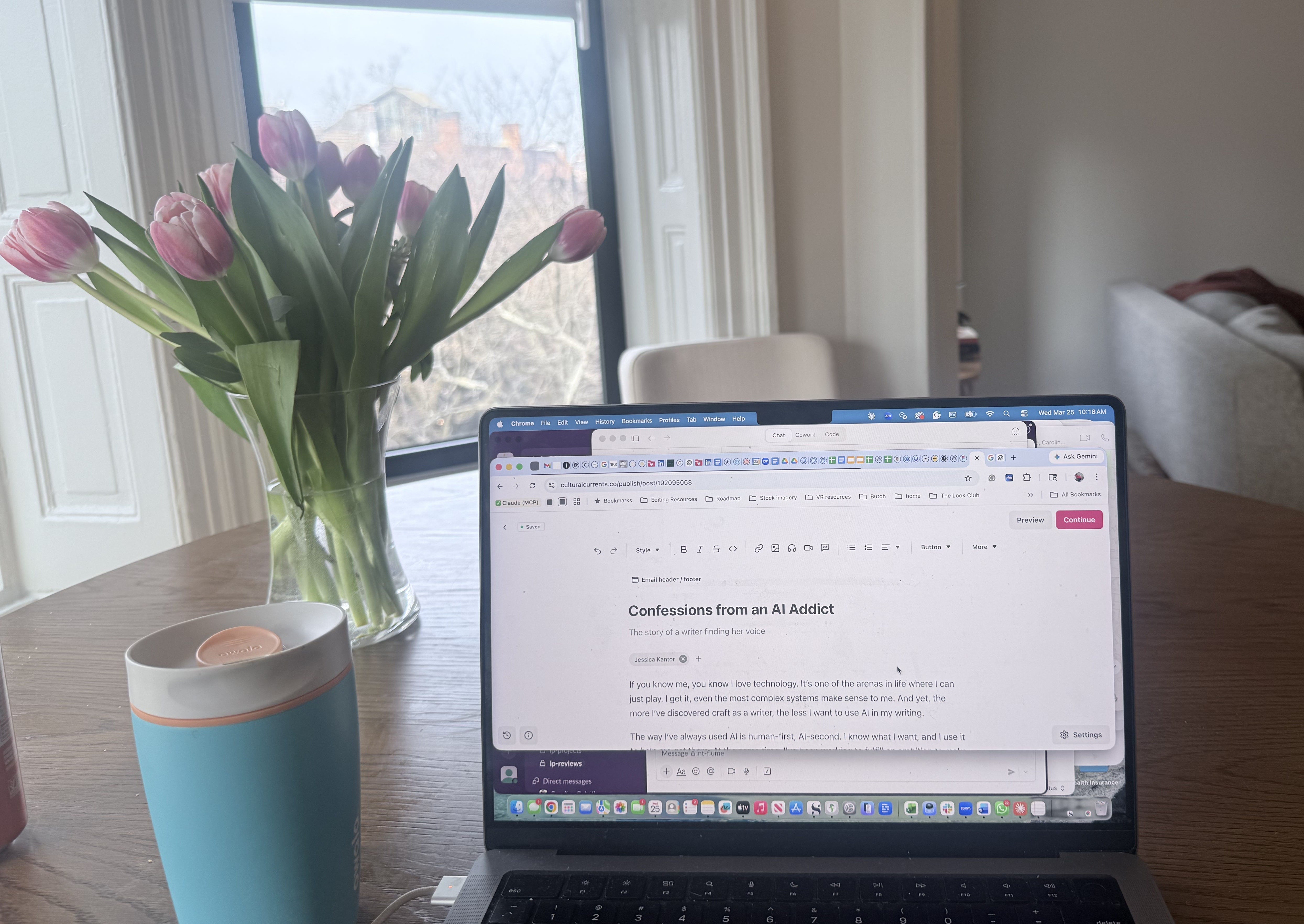
If you know me, you know I love technology. It’s one of the arenas in life where I can just play. I get it, even the most complex systems make sense to me. And yet, the more I’ve discovered craft as a writer, the less I want to use AI in my writing.
The way I’ve always used AI is human-first, AI-second. I know what I want, and I use it to help me get there. At the same time, I’ve been working to fulfill an ambition to make a living as a writer. But I’m insecure AF.
I love writing fiction, but when it comes to personal essays, I’m nervous about creating unfettered attention. It just feels to vulnerable to be out there, just me. Something about fiction feels like just enough veil that I can be authentic and honest with my characters, my story, my plot. But starting this substack and trying to find my voice, my authority, my red-dress energy, something in me didn’t trust myself.
Recently, I took a ballet class. This is a hard and fast tangent, but stay with me, I’ll bring it around, I promise. Something about being in that class and feeling my body move in space. I remembered why I always feel most myself in a ballet class. It’s the only place I’ve ever un-appolegetically taken up space. Letting the energy of my body move through the floor to the lava center of the earth and the top of my head, all the way to the outer reaches of the galaxy. It’s pure freedom to take up space in that way and share the infinite expansion of my energy way beyond my human shell.
So when I hit the page, why can’t I let my energy run through my words in the same way? I sit, I write, and I let my heart guide me. But then I’m nervous about spelling and grammar and saying things in the ‘right’ way. So I ran my essay through an LLM (typically ChatGPT and, more recently, Claude) and felt like they’d edit it in a voice acceptable to the world. And then I’d share it.
It was still my idea, the original drafts were mine, but it became cluttered with AI tropes, lots of em-dashes, and somehow the soul was sucked out of my words. The AI editor isn’t my friend. It is a machine that doesn’t know how to read. Small confession, I still use Grammarly. But it's really just for spelling and grammar checking.
As I mentioned before, I’ve been studying the craft of writing. I’ve been reading. Like, a lot. Mostly contemporary fiction, but honestly, anything I can get my hands on. And one day, not so long ago, something clicked. It was like I’d taken the red pill (or is it the blue pill, I can never remember), but a pill that took me inside the matrix. Only it wasn’t inside a computer graph, it was inside the multi-dimensional world of craft. It started with a simple thought, wow, this author feels like she is telling the story to an old friend (Lisa Phamm’s, Discipline), or the description is altering my olfactory senses, (Partick Suskind’s Perfume: A Story of a Murder), or wow, the engine of this story just hooked me from the jump, (Frederick Backman’s My Friends).
And then it dawned on me, AI is trained on data. But it’s not taught to read. It doesn’t know how to feel a book and let the world wash over it. A book rewires our brain; it quite literally creates new pathways, and if you don’t believe me, AI can tell you all about it. Kidding, check out some scientists who have written studies, which is likely where you’ll get the real information rather than TikTok University.
So after this discovery, I started to feel really anxious. Like, what in the heck have I done? I went back to my essays on cultural currents, and I saw some of the slop I was putting out into the world. I did that, all because I didn’t have the courage to be vulnerable. I was so scared to be mediocre that I made myself bad. So, as of right now, I’m stopping, and risking being bad, and letting you see my holes, cause its better to meet me the human than hide behind a layer of machine learning.
And so, I’m going to write an unfiltered, lightly self-edited essay each week. About the stuff that’s on my mind, and I’m going to publish it without any AI assistance. Not even an AI image. To practice being vulnerable. Cause soon enough, I’ll be in submission on my novel, that’s all me, and that’s a f-ton of vulnerability to slingshot into the world without any practice opening my trench coat and exposing my soul.
What’s AI Good For Anyway?
As writers, we can still use AI to support the business side of our careers and automate boring, mundane tasks, making more space for writing.
But like the recent announcement of the shutdown of SORA, it’s going to become clear, very quickly, that AI isn’t great at making art, and it’s just a waste of money and natural resources. Just because my body can produce song from my vocal cords does not mean I can sing. Just because AI can create words on a page does not mean it can write.
If you’re interested in exploring AI, here’s a list of things AI is good for, according to two LLMs - the below is copy and pasted from ChatGPT after searching the same thing in Claude):
Task automation - AI automates repetitive or manual tasks, including scheduling, data entry, and document processing.
Data analysis - AI processes large datasets to identify patterns, trends, and insights.
Customer support — We ALL HATE this one. How many times have you screamed - I WANT A HUMAN? - AI powers chatbots and automated systems to handle customer inquiries and support requests.
Recommendation systems - AI suggests products or services based on user behavior and preferences.
Marketing optimization - AI supports advertising performance, audience targeting, and campaign analysis.
Software development support - AI assists with writing, reviewing, and debugging code.
Education support - Not sure I want a bot to tutor my kid but maybe in creative game ways. - AI provides tutoring, explanations, and learning assistance.
Decision support - AI analyzes information to support business and operational decision-making.
P.S. I am using AI to handle all the SEO crap we need on the back end and to help this post be discoverable.